
Is "Learning Spanish" Actually a Goal?
26 February 2026
It sounds ambitious, but "learning Spanish" might be the reason you never start. Here’s the subtle mistake most people make, and how to fix it.


Thu Mar 05 2026
“Do I need more motivation, or more discipline?”
It sounds like a sensible question. But usually, it sends people in the wrong direction. Because the truth is, most goals need both. Not in equal amounts, and not at the same time, but both.
Some goals are easier to start with motivation. Others only move forward when discipline takes over. And some people naturally lean more towards one than the other.
That does not mean something is wrong with you. It means you are human.
Motivation gets you moving. Discipline keeps you moving when the mood changes.
We often talk as if disciplined people have some superpower and motivated people are just running on feelings. Real life is messier than that. You can be deeply motivated to change your life and still struggle to act on Monday morning.
You can also be incredibly disciplined in one part of your life and not even notice it.
That is where this gets interesting.
Motivation matters.
It is the spark. The emotional pull. The reason a goal feels alive enough to begin.
Psychologists Edward Deci and Richard Ryan, through Self-Determination Theory, found that motivation tends to be stronger and more sustainable when people feel three things: autonomy, competence, and relatedness. In plain English, we do better when the goal feels chosen, when we feel capable of making progress, and when we feel connected to something or someone that matters.
That helps explain why one person happily trains for a half marathon while another keeps putting off a simple walk. The activity is not the whole story. The meaning behind it matters too.
If a goal feels vague, or disconnected from who you are, motivation fades fast.
If it feels personal, possible, and meaningful, motivation tends to show up more easily.
Motivation is often highest at the beginning, when possibility still feels exciting.
The problem is not that motivation is bad. The problem is that motivation is unreliable.
It rises and falls with sleep, stress, progress, confidence, hormones, energy, weather, routine, and whatever sort of day you happen to be having.
So if your whole plan depends on “feeling like it”, your plan is fragile.
This is where discipline comes in.
Discipline is not about being hard on yourself. It is not barking orders at yourself like some kind of inner drill sergeant.
At its healthiest, discipline is simply the ability to do what matters, even when the feeling is not there.
That does not sound glamorous, but it is powerful.
Research on self-control by Angela Duckworth and colleagues suggests that people with stronger self-control are not always battling temptation more heroically. Quite often, they are better at building useful habits and routines, which means they need less effort in the moment. In other words, discipline is often quieter than people think.
It can look like:
That is still discipline.
Not dramatic discipline. Just effective discipline.
And that matters, because many people think they are undisciplined when really they just have not turned the behaviour into something repeatable yet.
This is where people get tripped up: They assume every goal should be approached in the same way.
But different goals ask different things of you.
A creative project might need motivation at the beginning, because you need emotional energy, excitement, and belief to get it off the ground.
Training for a race, recovering your finances, rebuilding your health, or writing a book often needs discipline more heavily, because progress depends on repeated action long after novelty disappears.
Some goals are emotionally driven. Some are structurally driven. Most are both.
That is why comparing yourself to someone else is so unhelpful. They may be pursuing a goal that suits their wiring, their season of life, or their energy far better than yours does.
The question is not “What works for everyone?” It is “What does this goal need from me now?”
At some point, motivation drops. That is normal. It does not mean the goal no longer matters.
Often it just means the goal has stopped feeling fresh, or the effort has become more real than the fantasy.
When that happens, a few things help.
First, reconnect to the reason. Not the vague reason, the real one. Why does this matter to you now? Why this goal? Why this season? Motivation often returns when the goal feels personal again.
Second, shrink the action. Research on implementation intentions by Peter Gollwitzer shows that people are more likely to follow through when they decide in advance exactly when and how they will act. So instead of saying “I need to get back on track”, say “At 7am tomorrow, I will walk for 10 minutes.”
Third, create visible proof of progress. Progress is motivating. When people can see movement, they are more likely to continue. A simple streak tracker, checklist, or weekly score can do more for momentum than another pep talk.
Fourth, remove friction. If the task feels heavy, make the starting point lighter. Open the document. Put on the trainers. Prep the meal. Reduce the gap between intention and action.
Fifth, borrow motivation from other people. Accountability, encouragement, and social connection matter more than many people admit. We are not machines. Sometimes motivation comes back because someone asked how it is going.
Discipline can wane too.
That usually happens when life gets messy, the routine becomes too rigid, the plan is unrealistic, or you have been relying on willpower alone for too long.
When discipline drops, the answer is not always “try harder”. Often the answer is “make the system kinder and clearer.”
Start by lowering the minimum. A bad week is not the time for the perfect plan. It is the time for the version you can still do. Ten press-ups. One paragraph. Five minutes of admin. The disciplined move is the one you will actually repeat.
Then check the environment. Good discipline is often environmental, not heroic. If the phone is beside you, the snacks are visible, the calendar is chaotic, and the task has no slot, discipline has to work far harder than it should.
Also look for decision fatigue. If you are making the same decision every day, discipline drains faster. Build defaults where you can. A regular time. A regular place. A regular first step.
And perhaps most importantly, stop confusing a wobble with failure. Missing once is life. Missing repeatedly without adjusting the system is where the real problem starts.
Discipline grows stronger when the plan is realistic enough to survive ordinary life.
People often talk about motivation and discipline as opposites.
They are not. They feed each other.
Motivation helps you begin. Discipline helps you continue. Then continued action creates progress, and progress often creates fresh motivation.
That loop matters.
You do not always need to feel inspired before acting. Quite often, the action creates the feeling. This is one reason disciplined behaviour can become easier over time. As routines form and progress becomes visible, you stop relying on emotion for every next step.
And yet motivation still matters, because it keeps the goal emotionally alive. It reminds you why the effort is worth it.
So the healthiest approach is rarely all motivation or all discipline. It is a relationship between the two.
This part is worth sitting with.
Many people say, “I just do not have discipline.”
But then they show up to work on time. They pay their bills. They keep promises to clients. They get the children ready. They make appointments. They answer messages. They keep entire households or teams moving.
That is discipline.
It may not look like the version you admire on Instagram, but it still counts.
Sometimes the issue is not that you lack discipline. It is that you have only learned to use it in areas where there is external structure, urgency, or consequence. That is exactly why we built The Accountability Club—to create that structure for personal goals.
Personal goals often have less of that, which means you have to create more of the structure yourself. That is a skill. Not a personality verdict.
How you think about yourself matters.
Research on willpower beliefs by Veronika Job, Carol Dweck, and Gregory Walton has suggested that people’s beliefs about willpower can shape how they perform after demanding tasks. Put simply, if you believe discipline always runs out quickly, you may start acting as if you are empty sooner.
That does not mean mindset solves everything. Sleep still matters. Stress still matters. Capacity still matters.
But beliefs matter too.
At the end of the day, if you think you need discipline, you probably do. You will start looking for it, talking about it, and trying to build it.
But it is also worth asking another question:
Where am I already being disciplined without giving myself credit for it?
That question can change the whole tone of the journey. Because now you are not building from zero. You are recognising existing evidence.
Maybe this is the real takeaway.
You do not need to become a perfectly motivated person.
You do not need to become a robot of pure discipline either.
You need to understand yourself well enough to know:
That is not weakness. That is maturity.
Everyone needs motivation and discipline to some degree. Everyone loses both at times. Everyone has goals that suit them more naturally and goals that ask them to grow.
So if you have been assuming there is something wrong with you because your energy is inconsistent, there probably is not.
You are normal.
The work is not to become someone else.
The work is to learn what helps you keep going.
You do not need to choose between motivation and discipline. You need to learn how they work together in your life.
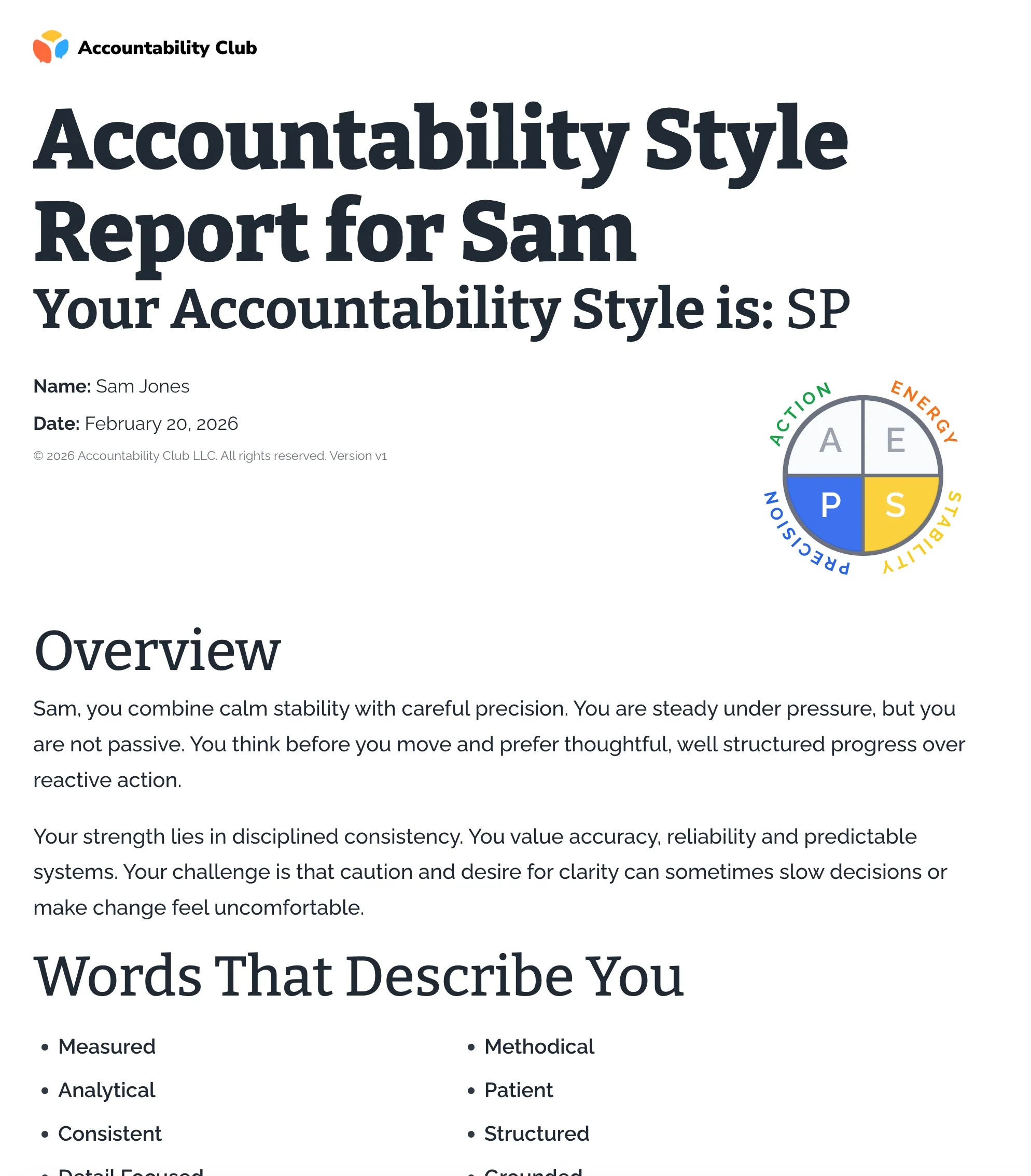
Take the Accountability Style Assessment and understand how you naturally start, stay consistent, and finish.
26 February 2026
It sounds ambitious, but "learning Spanish" might be the reason you never start. Here’s the subtle mistake most people make, and how to fix it.

19 March 2026
In reality, "failure" it is often just information. The real question is not whether you failed, but whether you learned something from it.